1. Application Background
The elevator door system is the most frequently operated mechanical component in any building — in a typical commercial installation, the doors open and close hundreds of thousands of times per year. As the direct interface between passengers and the elevator, door performance determines both ride quality and safety:
-
High duty cycle – doors operate dozens of times per hour, every day, for decades;
-
Strict safety requirements – passenger entrapment or clamping incidents are unacceptable, demanding certified, highly reliable obstruction detection;
-
Comfort expectations – passengers judge elevator quality by how quietly, smoothly, and precisely the doors move;
-
Diverse installations – passenger elevators, freight elevators, hospital elevators, and home lifts each impose different load and speed profiles;
-
Commissioning efficiency – with thousands of elevators installed annually, installers need fast, repeatable, error-free setup.
Conventional door machines controlled by relay logic or generic drives struggle with inconsistent torque at low speed, noisy operation, tedious manual tuning, and limited diagnostic capability. The FST-100 series door drive controller was developed to solve exactly these problems.
2. The FST-100 Series Solution
2.1 Product Overview
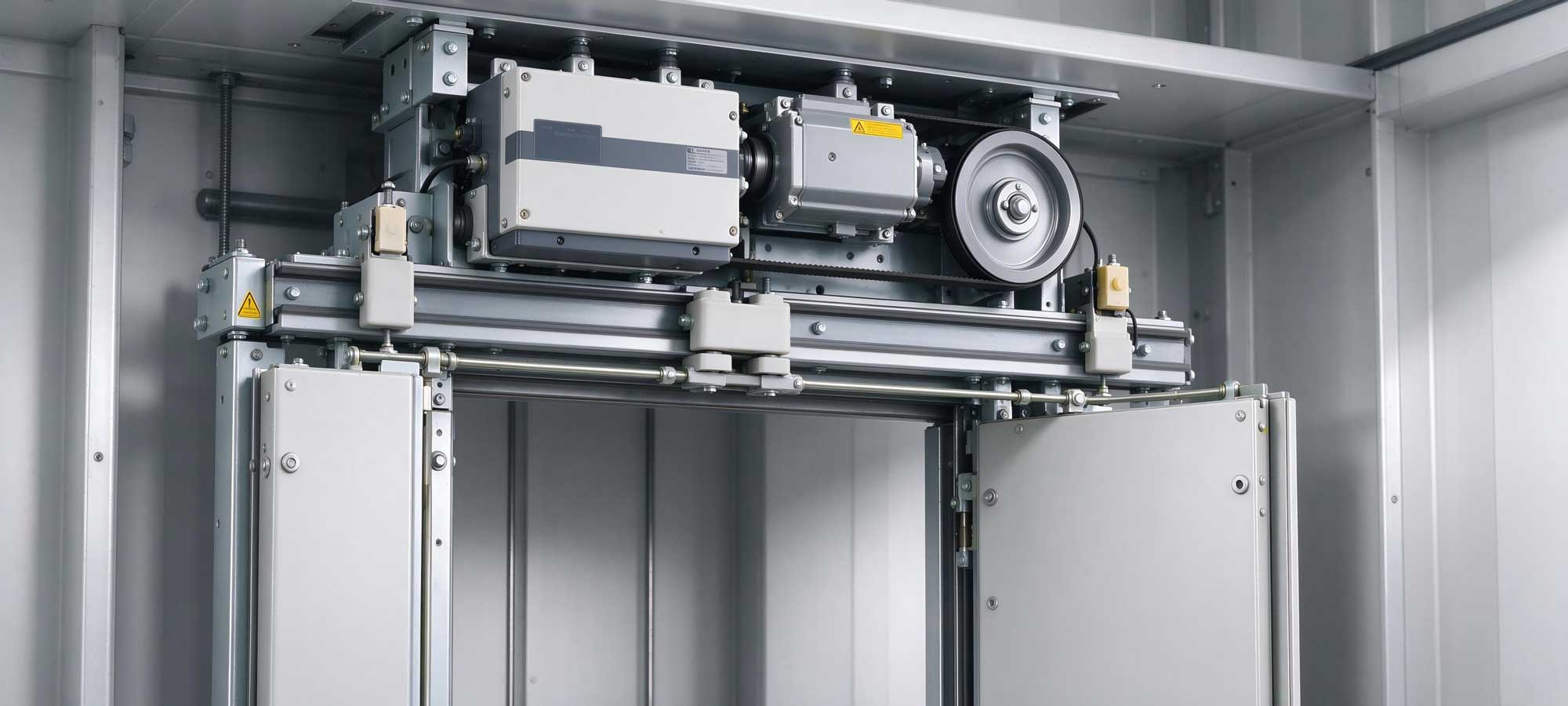
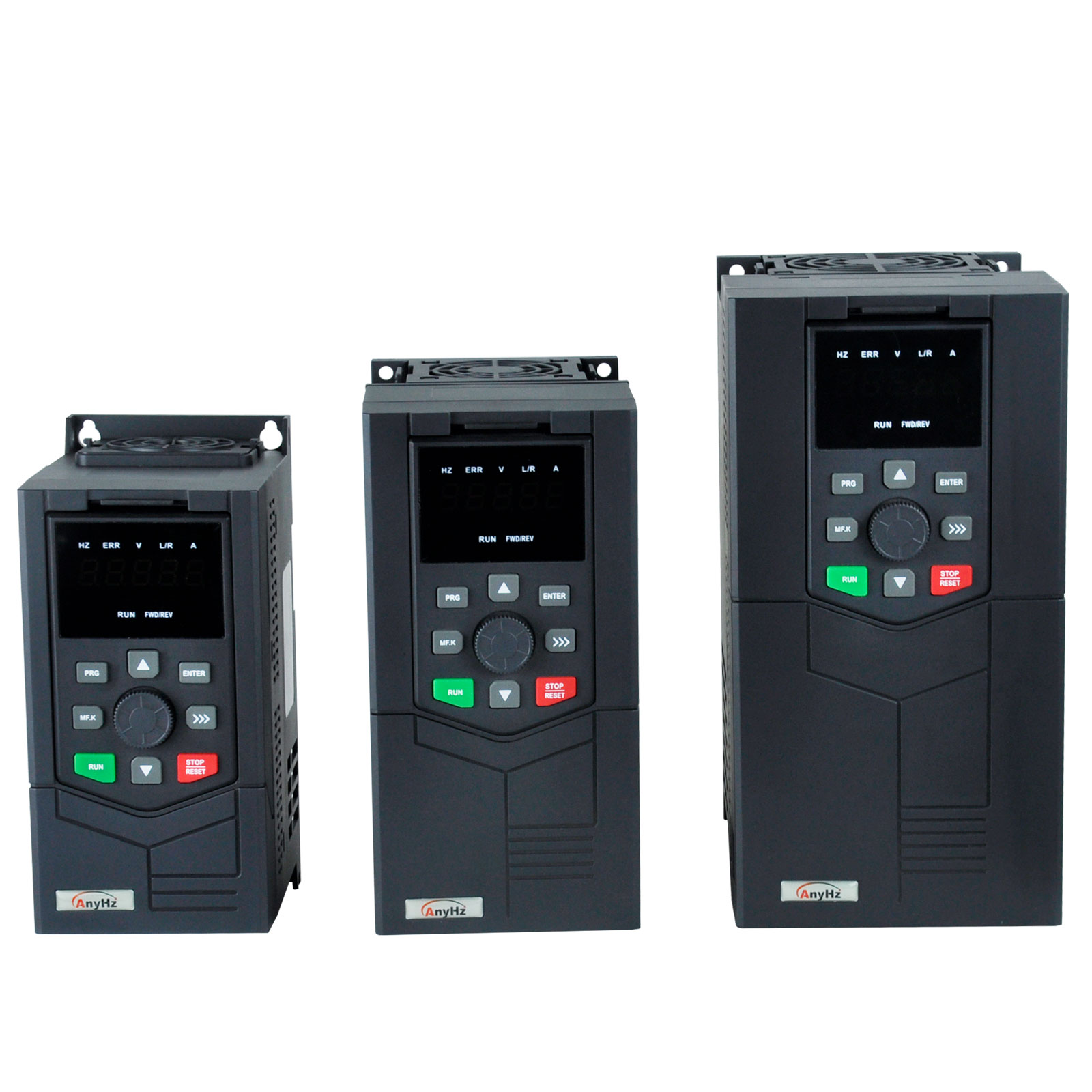
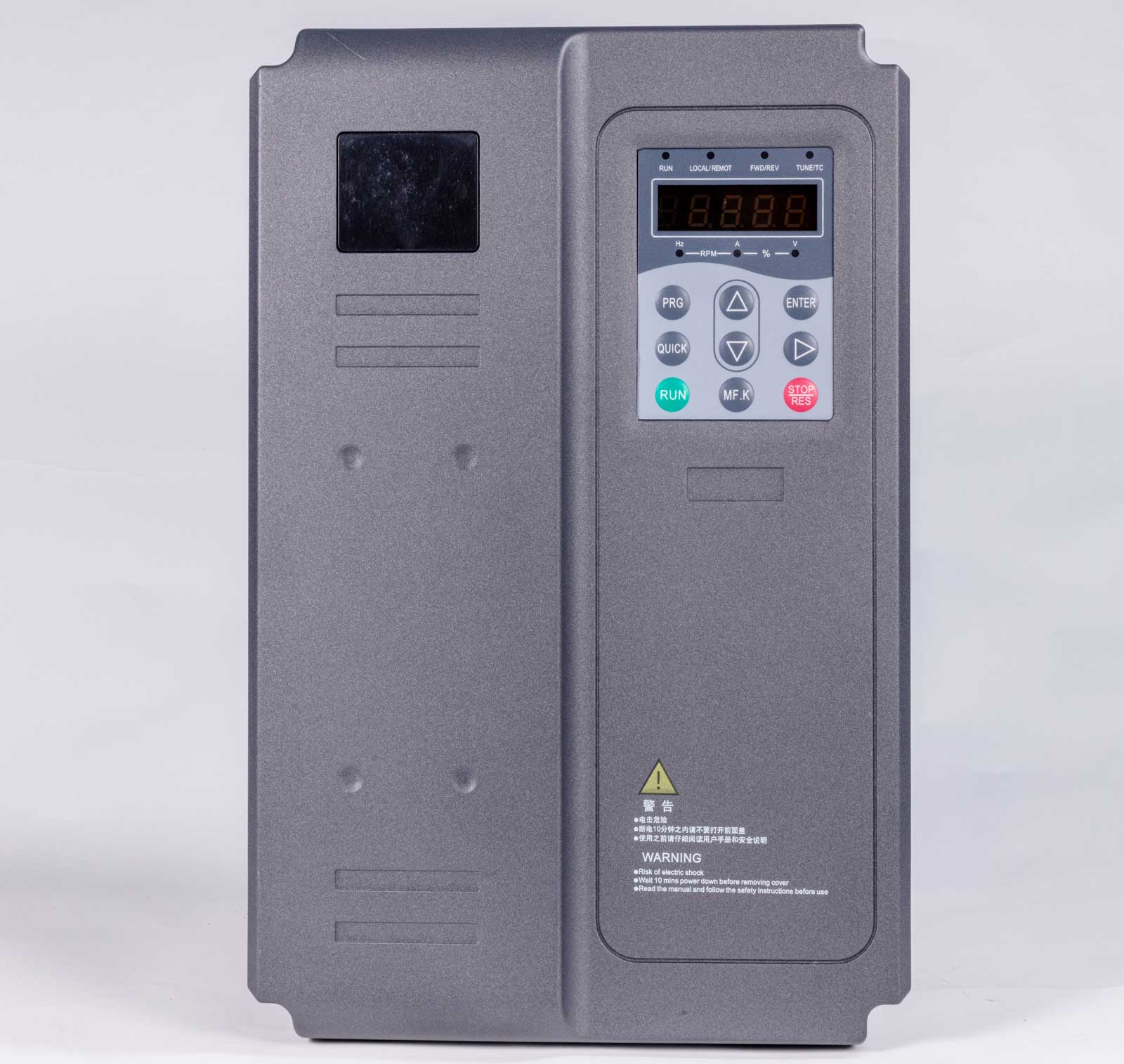
The FST-100 is a dedicated door drive controller that integrates door logic control and motor drive in a single compact unit. It drives both AC asynchronous and permanent magnet synchronous (PMSM) door motors, supports both speed control and distance control modes, and accepts open/close commands via digital I/O or RS-485 Modbus RTU — making it suitable for everything from modern machine-room-less (MRL) elevators to modernization retrofits.
2.2 System Architecture
Elevator control system (open/close commands, door zone signals)
            │  digital I/O  or  RS-485 Modbus RTU
            ▼
   FST-100 Door Drive Controller
   (logic + drive integrated, S-curve profile, torque monitoring)
            │  three-phase 220V output
            ▼
   Door motor (AC asynchronous / PMSM, optional encoder for distance mode)
            │
   Door operator mechanism → car door + landing door (via vane/vane-less)
Because logic and drive are integrated, the elevator controller only needs to issue simple open/close commands — the FST-100 manages the complete door motion profile, torque supervision, and fault handling internally. This dramatically simplifies wiring, reduces control cabinet size, and shortens commissioning time.
3. Key Features for Elevator Door Applications
3.1 One-Key Commissioning & Self-Learning
The FST-100 features one-key commissioning with automatic curve generation. After mounting, the installer triggers the learning routine once: the controller measures the door travel, identifies friction and inertia, and generates an optimized S-curve profile (acceleration — high speed — deceleration — creeping — closing force). Commissioning that traditionally takes 30–60 minutes of manual tuning is completed in 2–3 minutes, with consistent results across every elevator in a project — a major advantage for large residential or commercial batches.
3.2 Speed Control & Distance Control Modes
-
Speed control mode: time-based profile switching, ideal for cost-sensitive modernization projects without encoders;
-
Distance control mode: with an ABZ encoder, the controller learns the exact opening width and positions every speed transition by travel distance. This enables precise partial opening, accurate re-leveling of the door at every floor, and consistent performance regardless of supply voltage or load changes.
3.3 Smooth S-Curve Motion & Quiet Operation
Flux-vector control delivers 150% starting torque from as low as 1 Hz, ensuring reliable door breakaway under any load — including stiff landing door rollers or cold, viscous lubricant in unheated machine rooms. The generated S-curve eliminates jerks at the start and end of travel, reducing mechanical wear on rollers, belts, and linkages while giving passengers a premium, quiet ride experience. Door operating noise is significantly lower than with relay-controlled or generic-drive systems.
3.4 Comprehensive Safety: Obstruction Detection & Anti-Clamping
Passenger safety is engineered in at multiple levels:
-
Automatic obstruction detection — torque and speed feedback are analyzed in real time; if the door meets an obstacle, the controller stops or reverses within milliseconds. Sensitivity is adjustable in multiple levels to suit passenger, freight, or hospital elevators;
-
Power-loss anti-clamping protection — in the event of a power failure, the door system remains in a safe state, preventing uncontrolled movement;
-
Closing force limitation — the final closing torque is constrained to a safe, compliant level, protecting passengers while still ensuring the door locks reliably.
3.5 Protection & Diagnostics for Maximum Uptime
The FST-100 provides over-voltage, under-voltage, over-current, output phase-loss, and short-circuit protection, plus overload capacity of 150% rated current for 1 minute and 180% for 1 second. Fault codes are displayed on the integrated LED panel and readable via RS-485, allowing maintenance teams to diagnose issues remotely and restore service quickly — critical for elevators, where every hour of downtime is visible to building users.
4. Typical Application Cases
Case 1 — Residential elevator batch project. An elevator OEM equipped 120 MRL passenger elevators with FST-100-0R2S2 (200W) controllers driving PMSM door motors in distance-control mode. Two commissioning engineers completed self-learning and parameter verification for all 120 units in three days. The installer reported a ~70% reduction in door commissioning time versus their previous drive-based solution, and end customers noted visibly smoother, quieter door operation.
Case 2 — Freight elevator retrofit. An aging freight elevator suffered from door mis-closing and frequent clamping incidents under heavy load. Retrofitting with FST-100-0R4S2 (400W) in speed-control mode, combined with obstruction reversal and adaptive holding torque, eliminated clamping incidents entirely and allowed the door to close firmly and consistently even with warped, heavy landing doors.
Case 3 — Hospital elevator. For a hospital where silent, gentle operation and absolute safety are mandatory, the FST-100 was configured with low-level obstruction sensitivity and extended creeping distances. The soft S-curve profile and quiet PMSM drive met the strict acoustic requirements of the ward environment.
Door drive controllers of the FST-100 series are widely deployed in elevator door modernization projects, delivering flexible solutions from light passenger doors to heavy-duty freight doors.
5. Model Selection Guide
| Application |
Recommended model |
Notes |
|
Home lifts, light passenger doors (≤200W)
|
FST-100-0R2S2 (200W / 1.3A)
|
Self-cooled, compact, quiet
|
|
Standard passenger elevators
|
FST-100-0R4S2 (400W / 2.3A)
|
Fan-cooled, most widely used
|
|
Freight elevators, heavy/wide doors
|
FST-100-0R7S2 (750W / 4A)
|
High torque for heavy door panels
|
All models share the same dimensions (215 × 145 × 65 mm) and mounting cutout, simplifying BOM management and enabling easy power upgrades within a platform.
6. Conclusion
Elevator doors must be fast, silent, safe, and serviceable — for millions of cycles. With integrated logic and drive, one-key self-learning, dual control modes, adaptive torque management, and multi-layer protection, the FST-100 series door drive controller gives elevator OEMs and modernization contractors a standardized, easy-to-commission platform that improves ride quality, enhances passenger safety, and reduces lifetime maintenance costs — from residential MRL elevators to heavy freight lifts.



 Contact Us


