Abstract
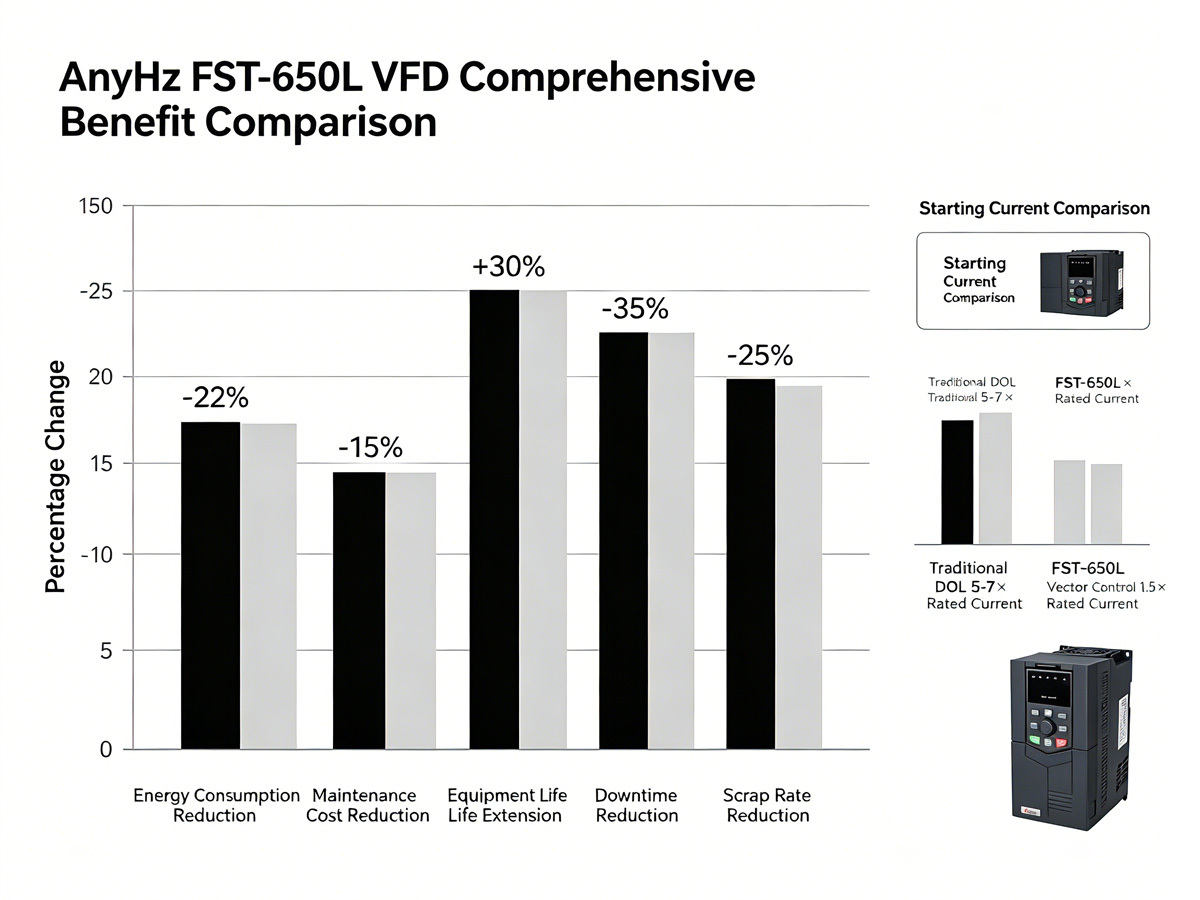
This paper focuses on the deep integration of AnyHz FST-650L series variable frequency drives in automated production lines, systematically demonstrating how variable frequency drive systems achieve leapfrog improvement in production efficiency through vector control, intelligent communication, and energy management. Combining typical application scenarios such as textile, papermaking, and machine tools, the paper analyzes the technical differences between V/F control and vector control, providing industrial users with a full-link practical guide from equipment selection to system integration. Verified by real production line data, automated systems integrated with AnyHz FST-650L VFDs can achieve comprehensive benefits of 22% energy consumption reduction, 15% maintenance cost reduction, and 30% equipment life extension.
1. Introduction: Energy Efficiency Challenges and VFD Technology Value
In the context of Industry 4.0 and intelligent manufacturing transformation, automated production lines face three core challenges: high energy consumption (motors account for over 65% of industrial electricity usage), insufficient control precision (traditional start-stop methods cause significant mechanical stress), and poor system compatibility (difficulty in multi-device coordination). The AnyHz FST-650L series VFDs precisely regulate motor speed and torque by changing voltage and frequency, not only reducing energy consumption but also minimizing mechanical wear and extending equipment lifespan.
2. AnyHz FST-650L Series: Core Product Features
2.1 Product Positioning and Technical Advantages
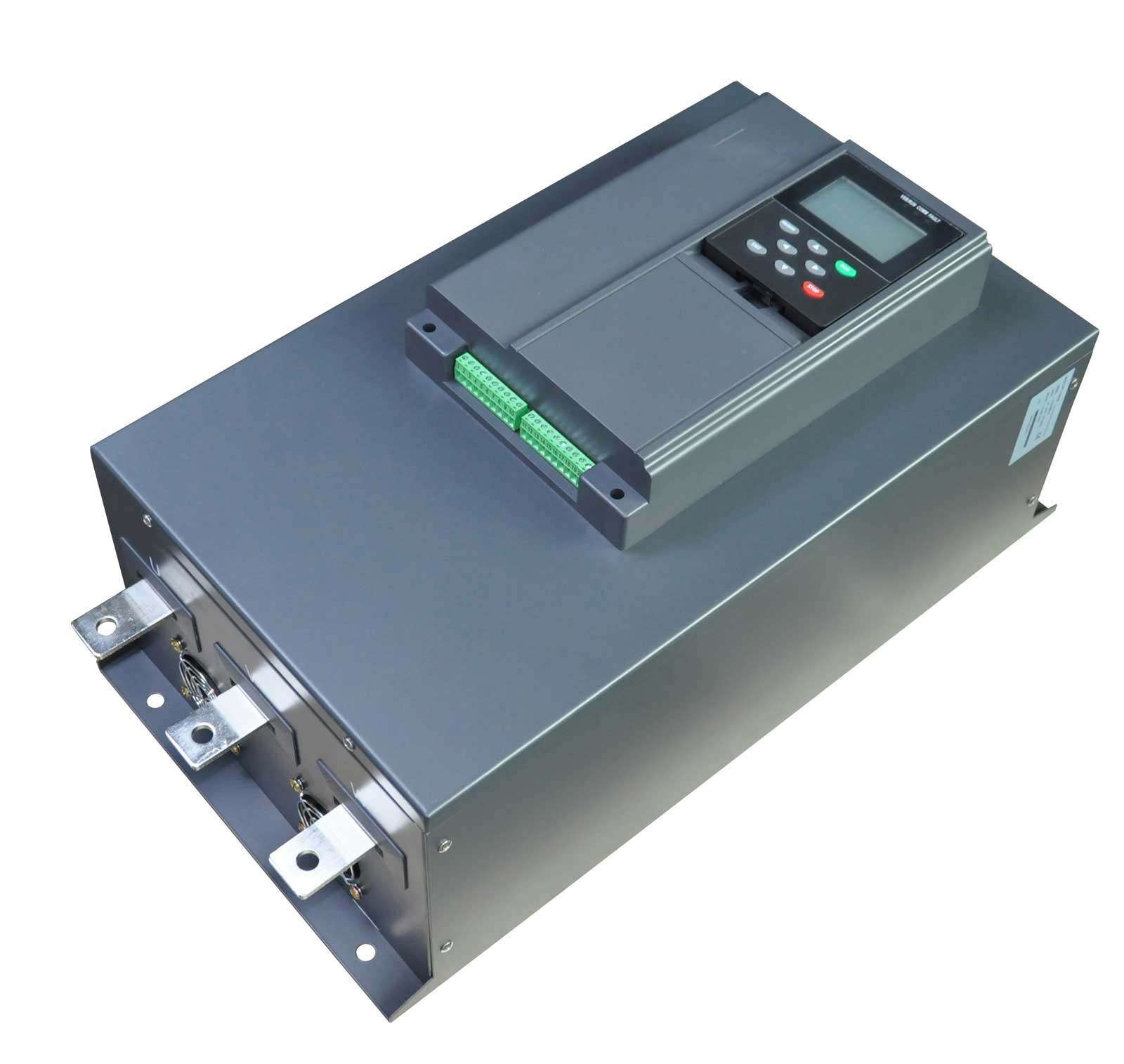
The FST-650L Vector Control Inverter represents AnyHz's flagship solution for high-performance industrial applications:
-
High-Performance Vector Control: Advanced coordinate transformation technology enables independent control of magnetic field current and torque current, delivering exceptional low-speed high-torque output and stable performance under demanding conditions
-
Robust Function Set: Rich and powerful functions designed for complex automation scenarios, including automatic torque compensation, slip compensation, and multi-speed control
-
Superior Dynamic Response: Fast torque response speed and excellent low-frequency torque characteristics, making it ideal for applications requiring high-speed control precision
-
Industry Versatility: Suitable for textile, papermaking, filament drawing, machine tools, packaging, food processing, fans, pumps, and other automated production equipment
2.2 Comparison with FST Series Product Matrix
| Model |
Control Mode |
Key Features |
Primary Applications |
|
FST-650L/610
|
High-Performance Vector
|
Low-speed high torque, rich functions, stable performance
|
CNC machine tools, fans and water pumps, crushers and sand making machines, etc.
|
|
FST-380L/820/860/880
|
Elevator Series
|
Speed control, torque response, low-frequency torque
|
Elevators, cranes, winding equipment
|
|
FST-630/631
|
Mini Vector
|
Compact, low noise, automatic compensation
|
Fans, pumps, conveyors, packaging
|
|
FST-500
|
Mini Vector
|
Ultra-quiet, compact 0.4-7.5kW
|
Light industrial automation
|
The FST-650L stands out as the optimal choice for automated production lines requiring both high precision and heavy-duty performance.
3. Automated Production Line Integration Solutions
3.1 System Architecture Design
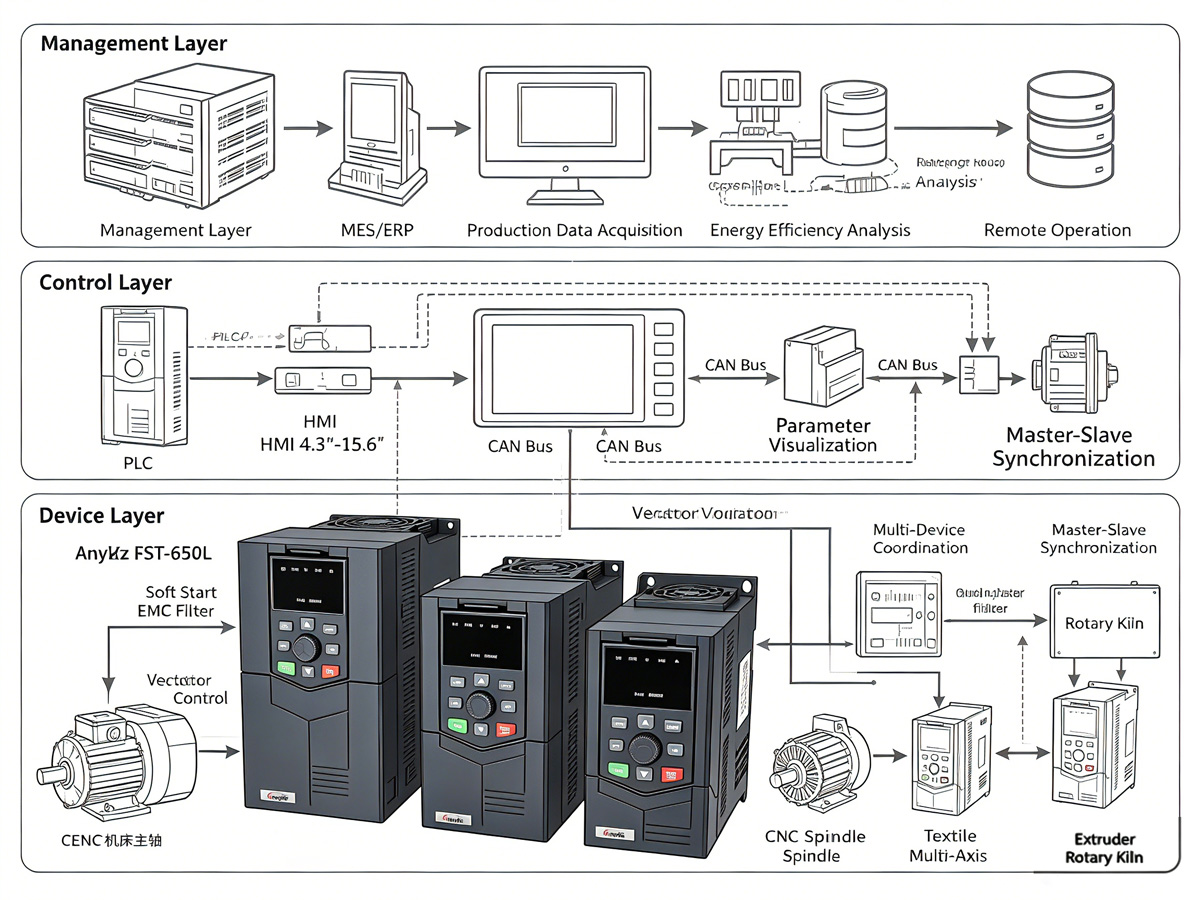
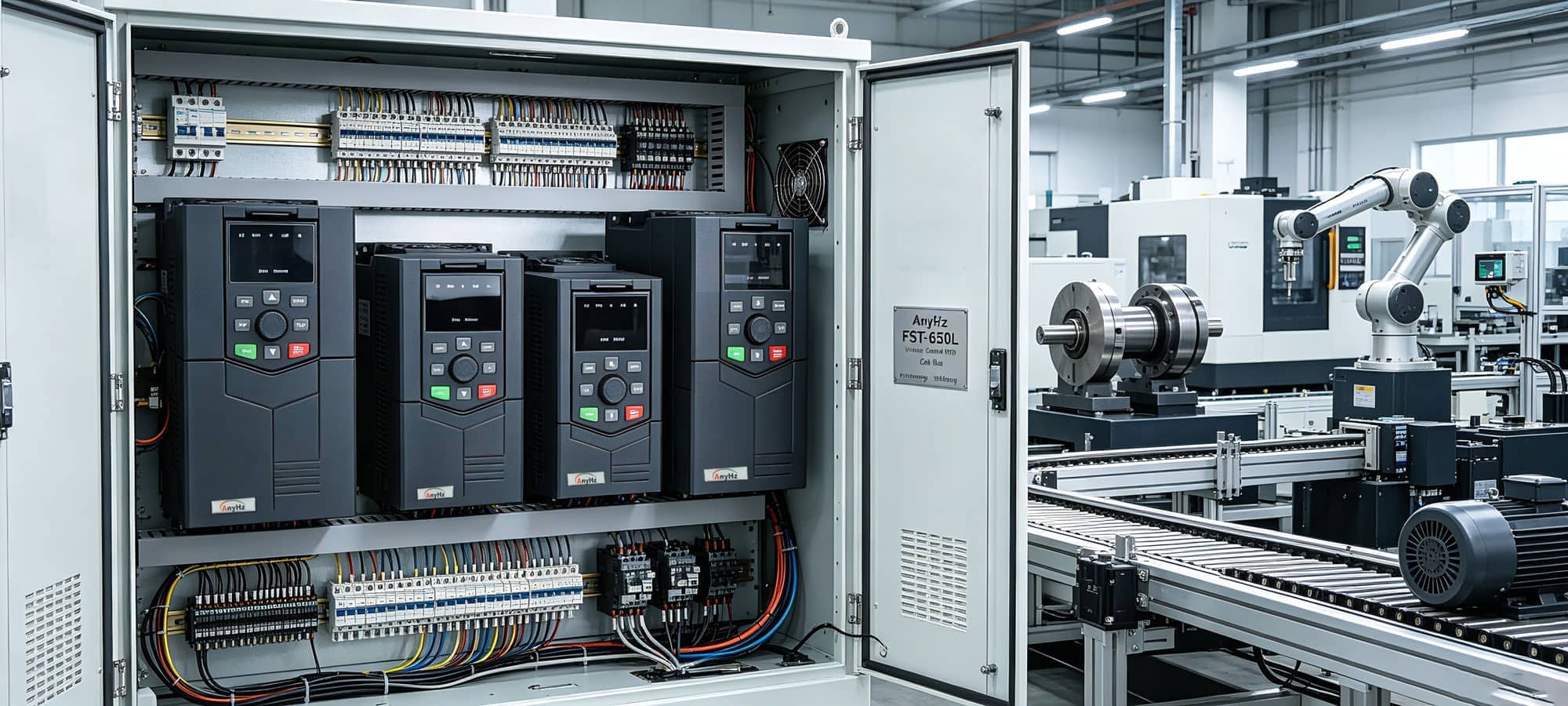
A typical integrated architecture comprises three layers:
-
Device Layer: AnyHz FST-650L VFDs driving AC asynchronous/synchronous motors with vector control precision
-
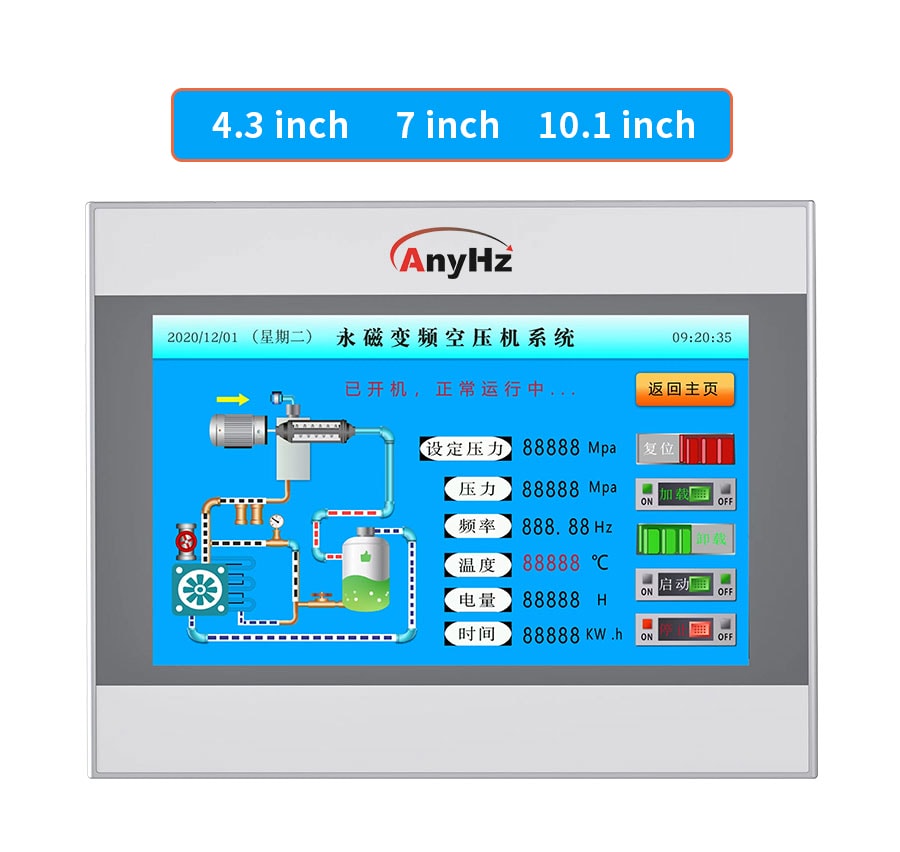
Control Layer: Industrial HMI touch screens (4.3" to 15.6") enabling parameter visualization and remote monitoring, with seamless communication to PLCs and servo drives
-
Management Layer: Integration with MES/ERP systems for real-time production data acquisition and energy efficiency analysis
3.2 Key Application Scenarios
Scenario 1: CNC Machine Tool Spindle Drive
-
Pain Point: Traditional direct-on-line starting generates 5-7x rated current surge, causing severe grid impact and mechanical stress
-
Solution: FST-650L vector control VFD with S-curve acceleration/deceleration profile, limiting starting current to 1.5x rated current
-
Results: 60% reduction in grid impact, 30% extension of spindle bearing life, ±0.5% speed accuracy at low frequencies
Scenario 2: Textile Machinery Multi-Axis Synchronization
-
Pain Point: Multi-motor synchronization accuracy directly affects yarn quality; conventional control causes high breakage rates
-
Solution: FST-650L VFDs networked via CAN bus, implementing master-slave synchronization with automatic torque compensation
-
Results: Breakage rate reduced by 40%, energy savings of 18%, synchronization accuracy within ±0.5%
Scenario 3: Plastic Extrusion Line
-
Pain Point: Extruders require high starting torque (150% rated) and precise temperature-speed coordination
-
Solution: FST-650L with 150% overload capacity for 60 seconds, integrated PID control for pressure maintenance
-
Results: Production efficiency increased by 25%, material waste reduced by 15%, annual energy savings of 35,000 kWh per line
Scenario 4: Rotary Kiln Heavy-Duty Application
-
Pain Point: 160kW rotary kilns experience 400A instantaneous current surges during material loading
-
Solution: FST-650L 160kW heavy-duty VFD with 380V input, designed to withstand 400A surges without tripping
-
Results: 22% electricity savings per ton of ash, 22,000 yuan annual maintenance cost reduction
4. System Reliability and Compliance
4.1 EMC Compliance
-
Function: Suppress electromagnetic noise generated by high-speed IGBT switching, preventing grid pollution and sensor interference
-
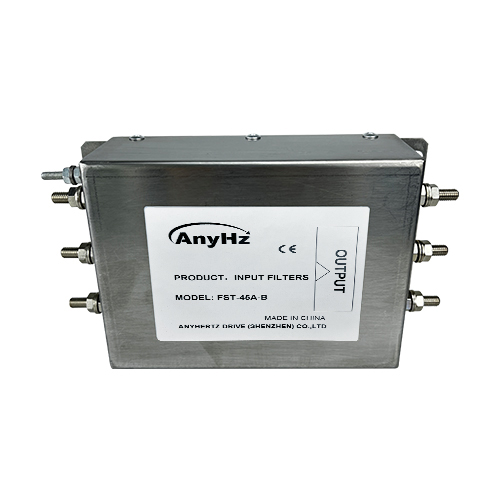
Components: Input/output filters (FST series), shielded cables, proper grounding
-
Standards: CISPR 11 Class A/B compliance, conducted emissions controlled within industrial limits
4.2 Power Quality Management
-
Function: Smooth pulsating DC after rectification, providing stable energy buffering for inverter stage
-
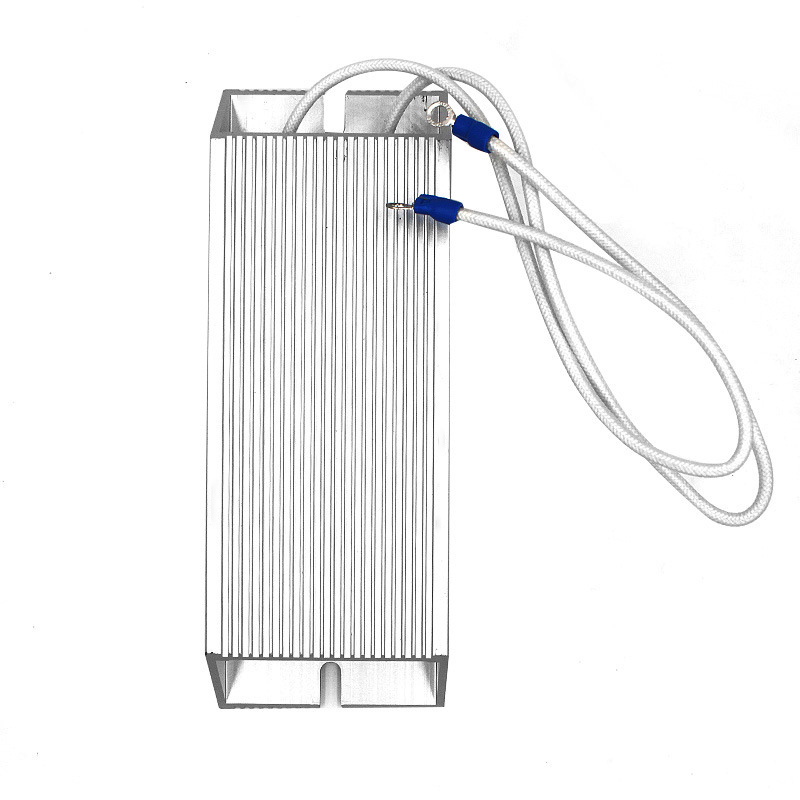
Components: DC bus capacitors, braking units, power inductors
-
Advantages: Adaptability to various frequencies, ripple currents, and temperature combinations ensuring long-term reliability
4.3 Protection Mechanisms
-
Input Protection: Soft start functionality, overvoltage/undervoltage protection, phase loss detection
-
Output Protection: Motor overcurrent protection, thermal overload protection, short circuit protection
-
Environmental Protection: IP20/IP54 enclosure options, conformal coating for harsh environments
5. Implementation Path and Best Practices
5.1 Selection Decision Matrix
| Application Scenario |
Recommended Model |
Control Mode |
Key Parameters |
|
CNC Machine Tools
|
FST-650L/610/500/630/631
|
Vector Control
|
Low-speed high torque, ±0.5% precision
|
|
Textile Multi-Axis
|
FST-650L
|
Vector Control
|
Synchronization, torque compensation
|
|
Plastic Extrusion
|
FST-650L/610
|
Vector Control
|
150% overload, PID control
|
|
Fan & Pump Systems
|
FST-630 / 610/650L
|
V/F Control
|
Energy saving priority, soft start
|
|
Light Packaging
|
FST-500
|
V/F Control
|
Compact, cost-effective
|
5.2 Installation and Commissioning Essentials
-
EMC Compliance: Install input filters, configure output reactors, and ensure shielded cable single-point grounding
-
Thermal Management: Maintain ≥100mm clearance between VFD and motor, ambient temperature control within -10℃ to +40℃
-
Parameter Optimization: Adjust carrier frequency (2-16kHz) based on load characteristics to balance noise and losses
5.3 Maintenance Strategy
-
Predictive Maintenance: Monitor DC bus voltage and output current harmonics via HMI to detect capacitor aging early
-
Spare Parts Management: Stock filter capacitors and cooling fans as consumables, improving MTBF by 30%
6. Comprehensive Benefit Assessment
Taking an automotive parts automated production line as an example, after integrating AnyHz FST-650L VFDs:
-
Energy Efficiency: Annual electricity savings of 120,000 kWh, approximately $15,000 cost reduction
-
Productivity Increase: Equipment downtime reduced by 35%, OEE (Overall Equipment Effectiveness) improved by 18%
-
Quality Improvement: Product dimensional tolerance controlled within ±0.02mm, scrap rate decreased by 25%
-
Maintenance Cost: Annual maintenance expenses reduced from 4,500 to3,000, a 34% decrease
7. Conclusion and Outlook
The AnyHz FST-650L series VFDs provide automated production lines with efficient, precise, and reliable drive solutions. As Industrial IoT (IIoT) evolves, VFDs will advance toward predictive maintenance, digital twins, and edge computing, continuously pushing the boundaries of intelligent manufacturing.



 Contact Us


