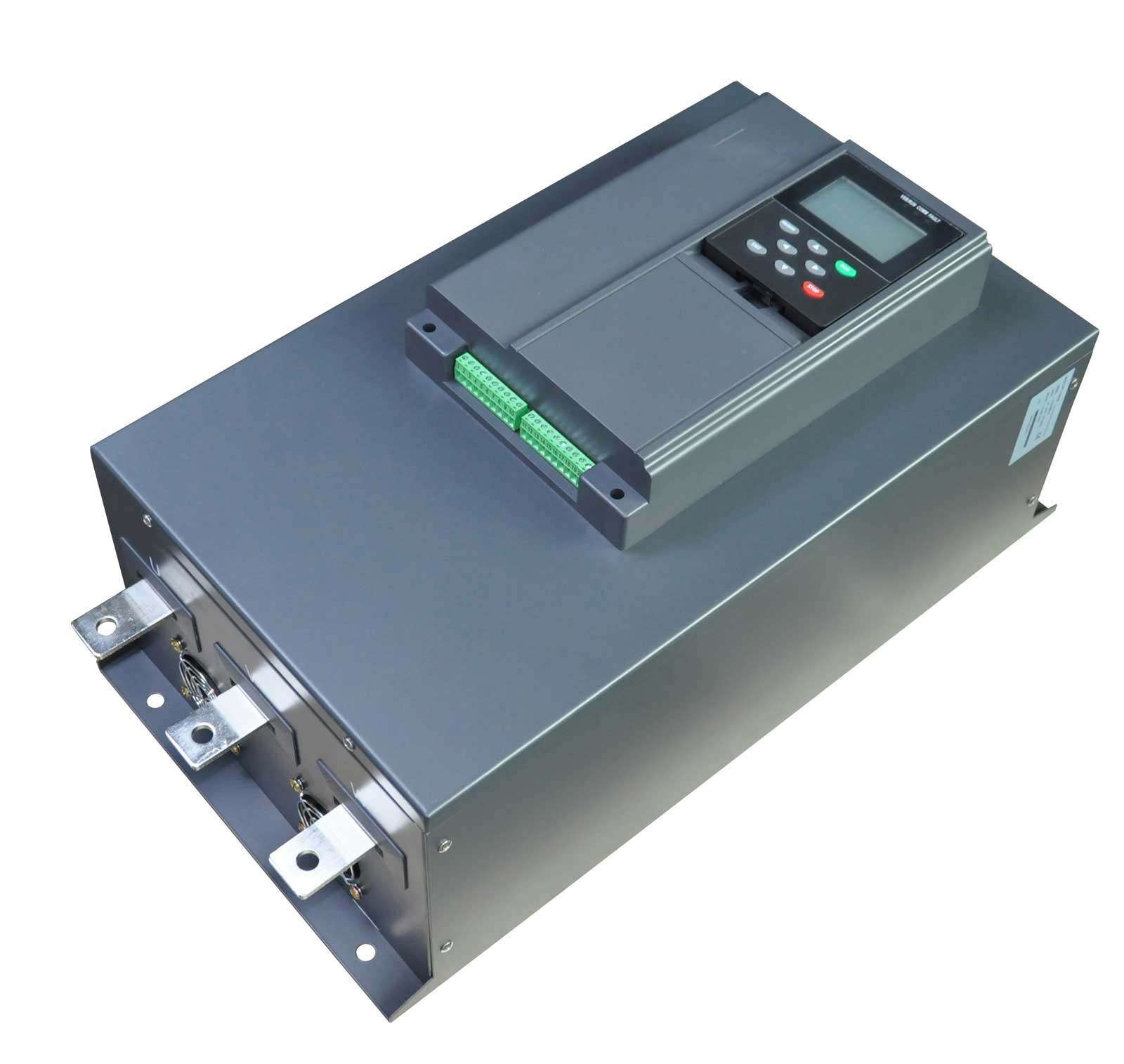
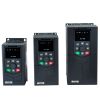
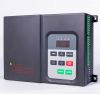
AnyHz FST-650L flux vector inverter upgrade transforms yarn production at a Tier-1 Bangladeshi textile exporter — eliminating mechanical gearboxes, stabilizing spindle tension, and delivering measurable gains in energy efficiency, yarn quality, and daily output across an 80-machine ring-frame fleet.
| 28% Energy Reduction |
+15% Daily Output |
–60% Yarn Breakage |
Client Background
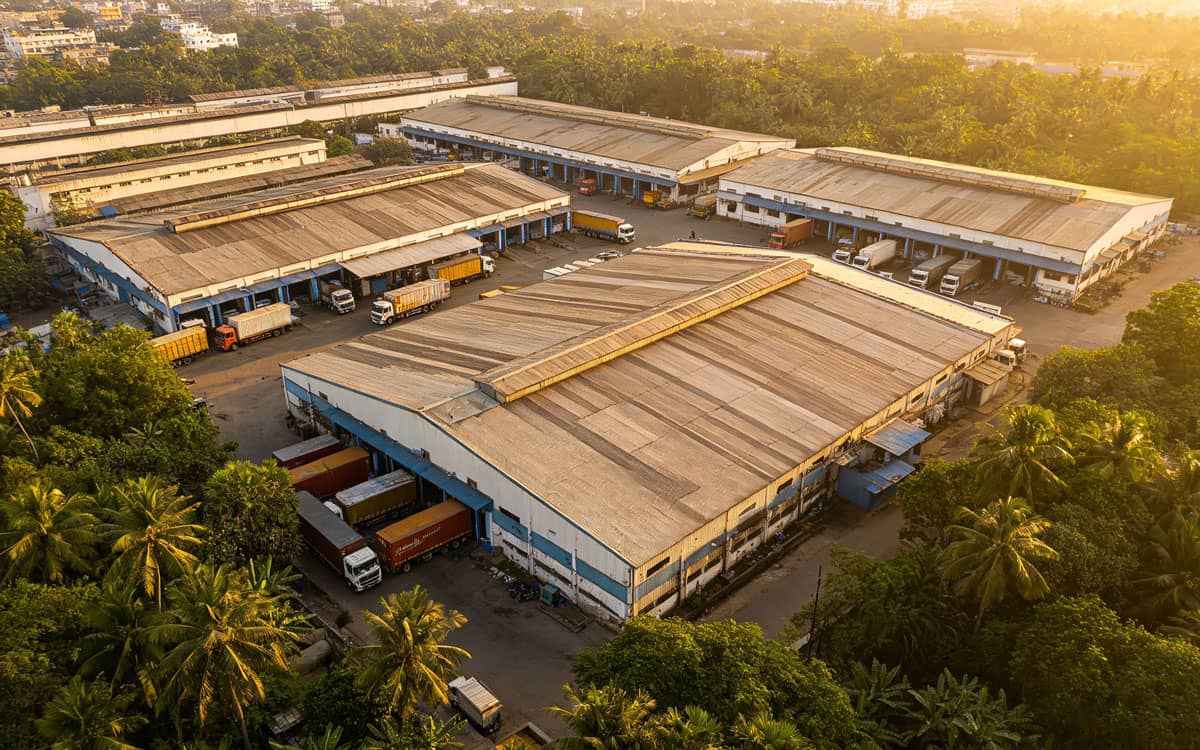
The client is a vertically integrated textile manufacturer located in the greater Dhaka region, Bangladesh. Established in the late 2000s, the company operates a 45,000 m² production complex employing approximately 2,400 workers and supplies ring-spun yarn to garment factories serving several major global fast-fashion brands.
Its spinning division runs 80 ring-frame machines (1,680 spindles per machine) producing Ne 30/1 carded cotton yarn for knitting applications. Prior to the retrofit, each machine was driven by a single 37 kW fixed-speed motor coupled to a 4-speed mechanical gearbox. Operators shifted gears manually to match spindle speed to the yarn count and draft ratio required by each production order.
Annual yarn output from the spinning hall was approximately 3,200 tonnes, with the facility running 22.5 hours per day, six days a week, in Bangladesh's competitive Ready-Made Garment (RMG) supply chain.
Challenges
A 2023 production audit conducted by the client's industrial engineering team identified five interconnected problems traceable to the mechanical gearbox drive architecture:
1. Yarn tension instability and high breakage rates
The 4-speed gearbox provided only coarse speed steps (1,200 / 1,500 / 1,800 / 2,100 RPM). Between these fixed ratios, operators could not fine-tune spindle speed to match the optimal twist-per-inch (TPI) for each cotton lot's micronaire and strength variation. The resulting tension spikes caused frequent end-breaks during doffing and high-speed winding.
-
Average end-breakage rate: 8.2 breaks per 1,000 spindle-hours
-
Impact: Each break required a piecer to stop the frame, locate the broken end, and re-thread the spindle — a 45–90 second interruption. Cumulative downtime across 80 machines consumed an estimated 3.8 productive hours per machine per day.
2. Inconsistent yarn quality between shifts
Because gear selection relied on operator judgment, different shifts frequently ran identical yarn counts at slightly different spindle speeds. Lot-to-lot variation in elongation and unevenness (U%) exceeded the ±3% tolerance demanded by premium European buyers, leading to quarterly quality claims and price penalties.
3. Excessive energy consumption
The fixed-speed motor ran at full 37 kW load regardless of actual draft demand. During low-tension winding phases and doffing cycles, the mechanical gearbox absorbed surplus power as heat and friction rather than reducing motor input. Power monitoring showed average motor loading of only 58% of rated capacity, yet energy draw remained constant.
-
Annual spinning-hall electricity cost: $186,000 (at $0.09/kWh industrial tariff)
-
Energy intensity: 1,850 kWh per tonne of yarn produced
4. Mechanical wear and maintenance burden
The gearbox clutch assemblies, dog gears, and sliding spline couplings required lubrication every 200 operating hours and replacement every 18–24 months. Gear-shifting shock loads also transmitted vibration to the spindle rails, accelerating bearing wear and requiring rail re-leveling every six months.
-
Annual gearbox maintenance: $24,000 in parts and labor
-
Unplanned downtime: 340 machine-hours per year due to gearbox and clutch failures
5. Noise and working environment
Gear mesh noise at the gearbox housing exceeded 82 dB(A) at operator positions, contributing to fatigue and complicating compliance with Bangladesh's factory noise regulations under the Bangladesh Labour Act, 2006.
Solution
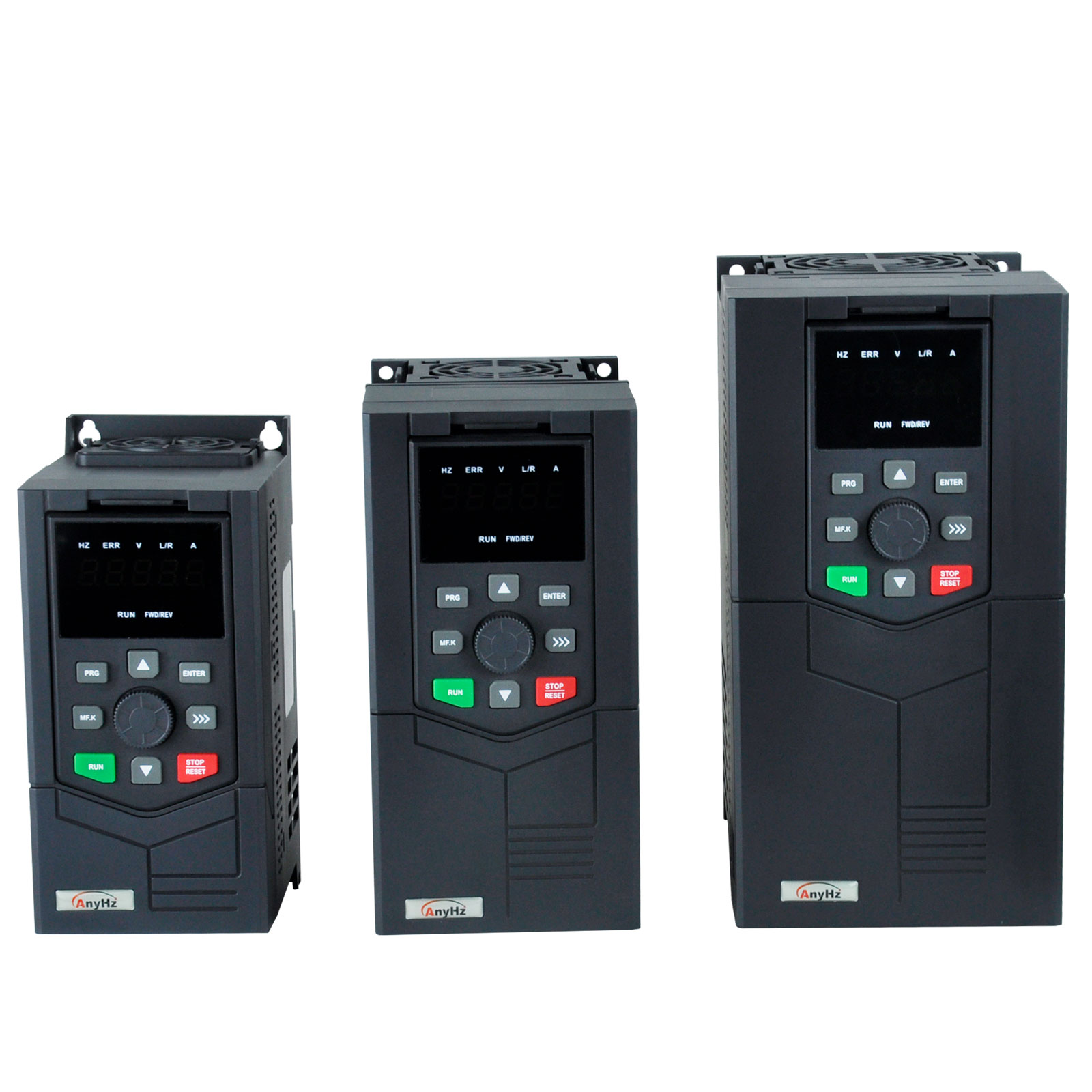
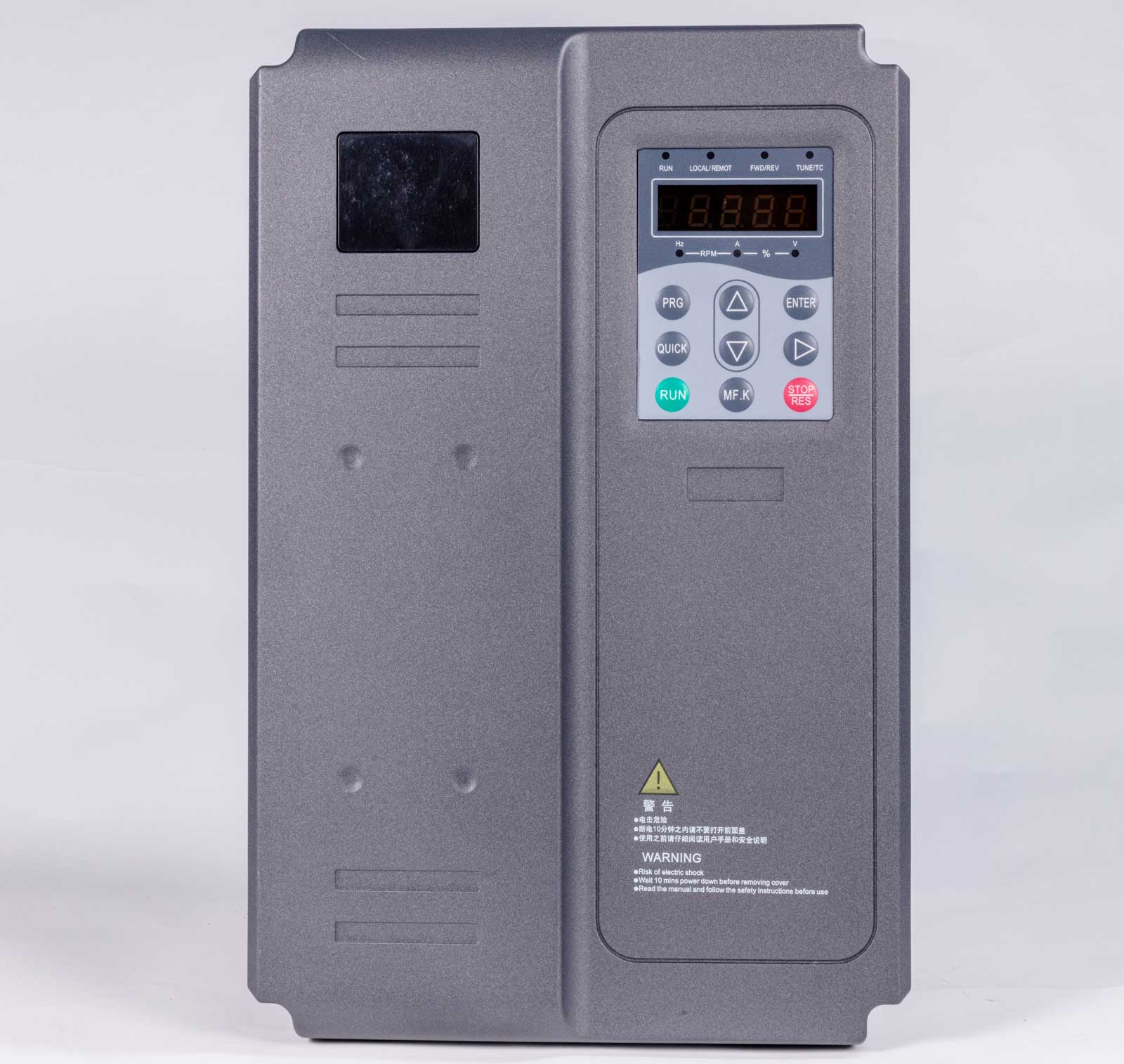
Following a competitive technical evaluation involving three inverter suppliers, the client's engineering team selected the AnyHz FST-650L series flux vector inverter for the full-fleet retrofit. The decision was driven by the drive's proven performance in textile spindle applications across India and Vietnam, its precise torque control at low speeds, and AnyHz's availability of local Bengali-speaking field engineers through its Dhaka service partner.
System Configuration — 80 Machines Retrofitted
| Component |
Specification |
Quantity |
|
Main drive
|
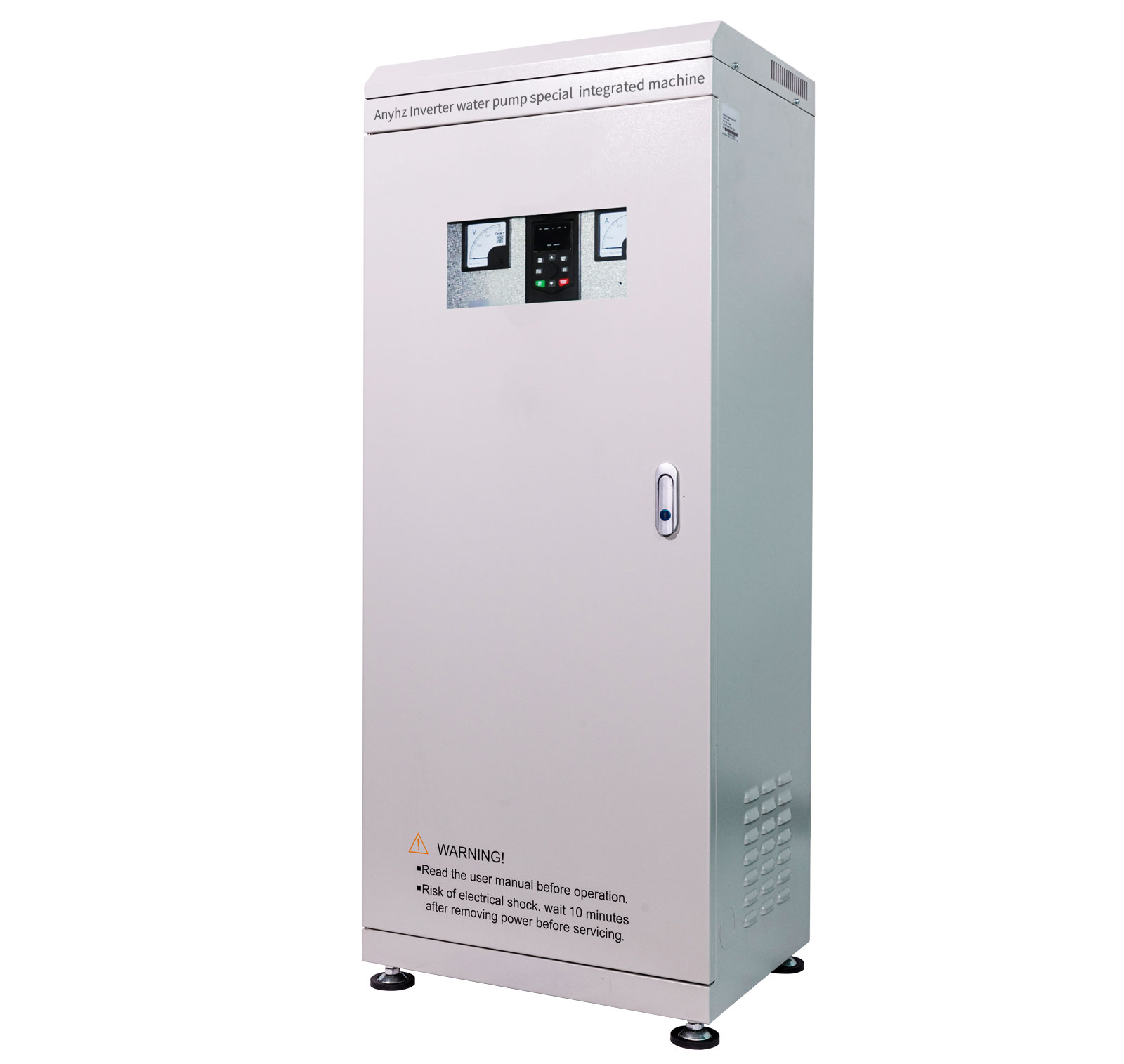
FST-650L-037G/045P-T4 (37 kW)
|
80 units
|
|
Braking resistor
|
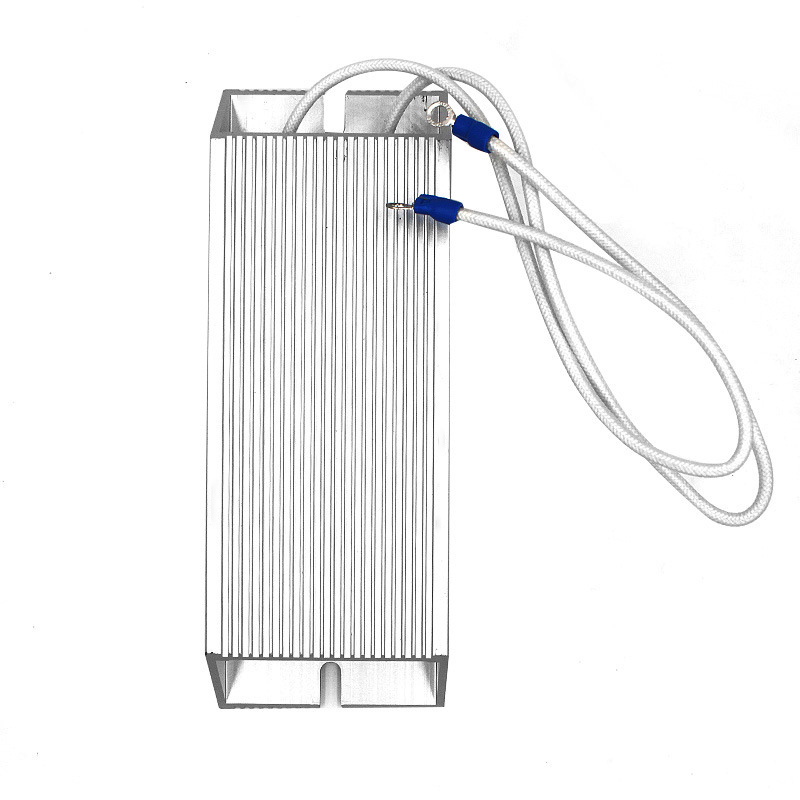
200 Ω, 1,500 W, IP20
|
80 units
|
|
Encoder
|
2,048 PPR incremental, shaft-mounted
|
80 units
|
|
Control panel
|
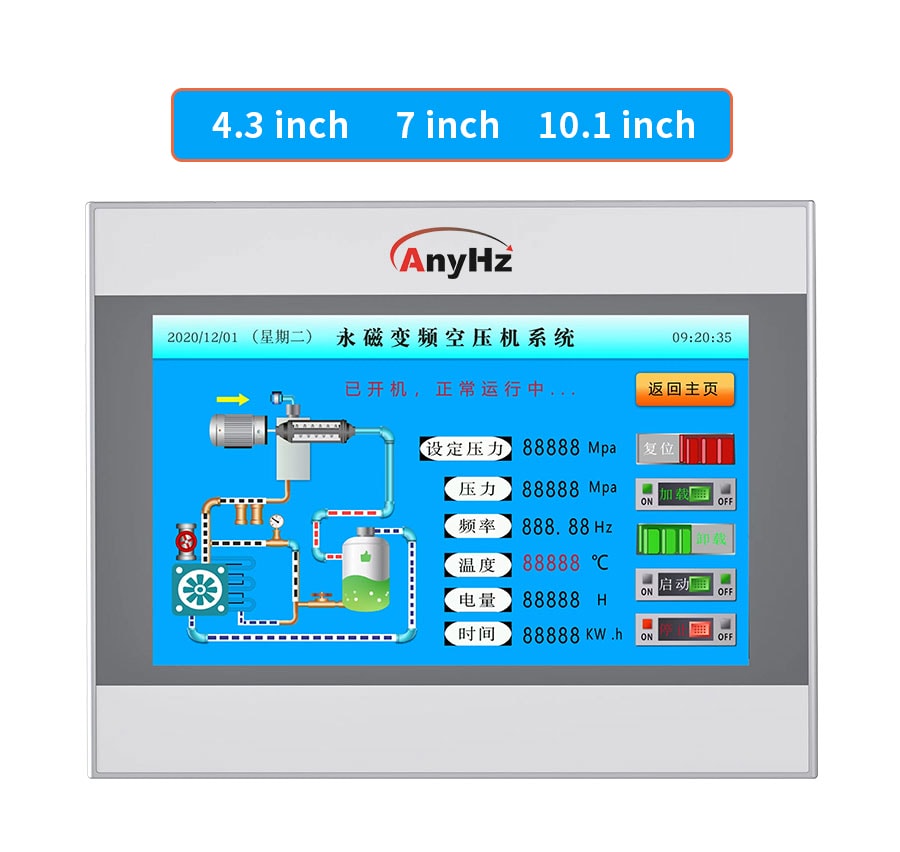
7" HMI with recipe storage
|
80 units
|
|
Communication
|
RS-485 Modbus RTU to mill DCS
|
1 system
|
Key Technical Capabilities Deployed
Closed-loop flux vector control — The FST-650L operates in full vector mode with encoder feedback, delivering ±0.02% speed accuracy and <5 ms torque response. This allows the inverter to hold precise spindle RPM even as yarn balloon tension fluctuates during cop build-up from empty to full bobbin.
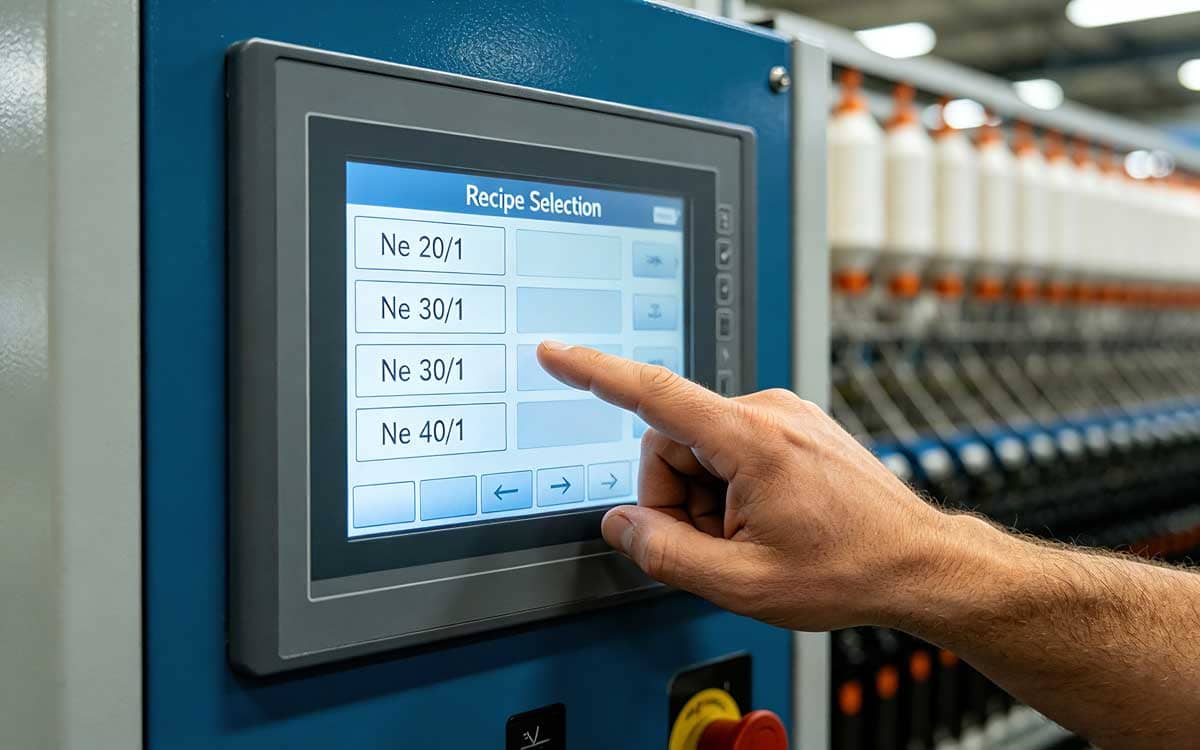
Programmable multi-step speed profiles — Each yarn count (Ne 20/1 through Ne 40/1) is stored as a named recipe in the HMI. The recipe defines:
-
Base spindle speed (RPM)
-
Draft ratio between front and back rollers
-
Twist-per-inch setpoint
-
Acceleration/deceleration ramps (S-curve, 8 s ramp to avoid yarn shock)
-
Doffing speed (reduced to 30% for safe operator access)
Operators now select the yarn specification from a touch-screen menu rather than manually shifting mechanical gears. Recipe consistency eliminates shift-to-shift variation.
Constant tension control via torque compensation — The FST-650L's built-in tension control algorithm modulates motor torque in real time based on a dancer-arm position feedback signal. As the cop diameter grows from 25 mm to 280 mm, the drive automatically reduces spindle RPM to maintain constant surface speed and yarn tension — a function impossible with fixed gear ratios.
Soft-start and mechanical shock elimination — Ramp profiles replace the abrupt mechanical engagement of gearbox clutches. Motor inrush current dropped from 6× rated to 1.2×, and peak torque transients during start-up were reduced by 70%, extending spindle-bearing life.
Energy-optimized V/F at partial load — During doffing, cleaning, and sliver-feed interruptions, the FST-650L transitions to energy-saving V/F mode, reducing magnetizing current when full torque is not required. Automatic sleep/wake logic pauses the drive if the sliver feed stops for more than 90 seconds.
Implementation
AnyHz's authorized Bangladesh partner managed the project in three phases to avoid disrupting committed delivery schedules to garment clients.
Phase 1 — Pilot (Weeks 1–4)
-
Retrofit 8 machines in Line A as proof of concept
-
Commission vector parameters, tune dancer-arm PID, validate recipe storage
-
Train 6 maintenance technicians and 12 machine operators
-
Run parallel production: 4 machines on new VFD, 4 on legacy gearbox for A/B comparison
Phase 2 — Line-by-line rollout (Weeks 5–14)
-
Retrofit remaining 72 machines at a rate of 8 machines per week
-
Work scheduled during Friday afternoon changeovers and Saturday maintenance windows
-
Each retrofit required: motor decoupling, gearbox removal, encoder installation, inverter panel mounting, parameter download, and 4-hour production trial
Phase 3 — Optimization (Weeks 15–18)
-
Fine-tune tension PID across all cotton lots (local vs. imported US cotton)
-
Integrate Modbus data feed into mill DCS for real-time OEE monitoring
-
Document standard operating procedures and emergency fault-response protocols
Total project duration: 18 weeks
Machines retrofitted: 80
Production disruption: Zero lost shifts (all work done during planned windows)
Results
Performance data was collected over a 12-month period (January–December 2024) and benchmarked against the 2023 pre-retrofit baseline.
Production & Quality
| Metric |
Before (2023) |
After (2024) |
Improvement |
|
Daily output per machine
|
178 kg
|
205 kg
|
+15.2%
|
|
End-breakage rate
|
8.2 / 1,000 spindle-hrs
|
3.3 / 1,000 spindle-hrs
|
–59.8%
|
|
Yarn unevenness (U%)
|
14.8%
|
12.1%
|
–18.2%
|
|
Elongation CV%
|
6.2%
|
4.9%
|
–21.0%
|
|
Lot-to-lot speed variation
|
±8% (operator dependent)
|
±0.3% (recipe controlled)
|
26× tighter
|
|
Customer quality claims
|
4 per quarter
|
0 in 12 months
|
Eliminated
|
The output gain of +15.2% was achieved without extending operating hours. The reduction in end-breaks alone recovered approximately 2.9 hours of productive time per machine per day previously lost to piecing interruptions.
Energy & Cost
| Metric |
Before (2023) |
After (2024) |
Improvement |
|
Annual spinning-hall electricity
|
$186,000
|
$133,900
|
–28.0%
|
|
Energy per tonne of yarn
|
1,850 kWh
|
1,332 kWh
|
–28.0%
|
|
Motor loading efficiency
|
58% average
|
89% average
|
+31 pts
|
|
Annual gearbox maintenance
|
$24,000
|
$3,200 (lubrication only)
|
–86.7%
|
|
Spindle bearing replacement
|
$18,500/year
|
$7,100/year
|
–61.6%
|
|
Noise at operator position
|
82 dB(A)
|
71 dB(A)
|
–11 dB
|
Financial Summary
| Item |
Amount |
|
Total retrofit investment (80 drives + accessories + installation)
|
$142,000
|
|
Annual energy savings
|
$52,100
|
|
Annual maintenance savings
|
$32,200
|
|
Annual quality penalty avoidance
|
$18,000
|
|
Total annual benefit
|
$102,300
|
|
Simple payback period
|
16.6 months
|
Environmental Impact
Client Testimonial
"The mechanical gearbox was the bottleneck we didn't know we had. We thought high breakage rates were just part of spinning coarse counts. After the AnyHz VFD retrofit, we realized that most of our breakage was caused by tension spikes during gear shifts and speed mismatches. Now our operators select the yarn count from a touchscreen, and every machine runs the same optimized profile. Our European buyers noticed the quality improvement immediately — we went from quarterly penalty discussions to receiving a supplier excellence certificate from one of our largest customers."
— Production Manager
Spinning Division
Leading Dhaka-Based Textile Exporter
Why AnyHz Was Selected
The client's evaluation committee cited four decisive factors:
-
Proven textile application firmware — AnyHz had already deployed over 600 FST-650L units in Indian and Vietnamese spinning mills, with documented performance data in ring-frame and rotor-spinning applications.
-
Local service presence — AnyHz's Dhaka partner provided Bengali-speaking engineers for commissioning, eliminating language barriers that had complicated previous automation projects with European suppliers.
-
Recipe management simplicity — The FST-650L's built-in multi-recipe storage (16 recipes per drive, expandable via HMI) allowed the mill to standardize all yarn counts without external PLC programming.
-
Total cost of ownership — While a European-branded alternative offered similar vector performance, its unit cost was 2.3× higher and its local spare-parts lead time exceeded 8 weeks. AnyHz's regional warehouse in Singapore guaranteed 72-hour parts availability.
Call to Action
Running a textile mill with mechanical gearboxes or outdated drives?
AnyHz has retrofitted over 600 spinning machines across South Asia. Our application engineers can audit your ring-frame or rotor-spinning fleet and model the energy, output, and quality gains available from a vector inverter upgrade.



 Contact Us


