How to Verify a Frequency Converter Supplier in China: A Complete Buyer's Guide

Views: 6 Author: Site Editor Publish Time: Origin: Site
Introduction

China is the world's largest manufacturing hub for industrial automation components, including frequency converters (VFDs). With thousands of suppliers ranging from global brands to small workshops, distinguishing reliable manufacturers from trading companies—or worse, low-quality producers—can be challenging.

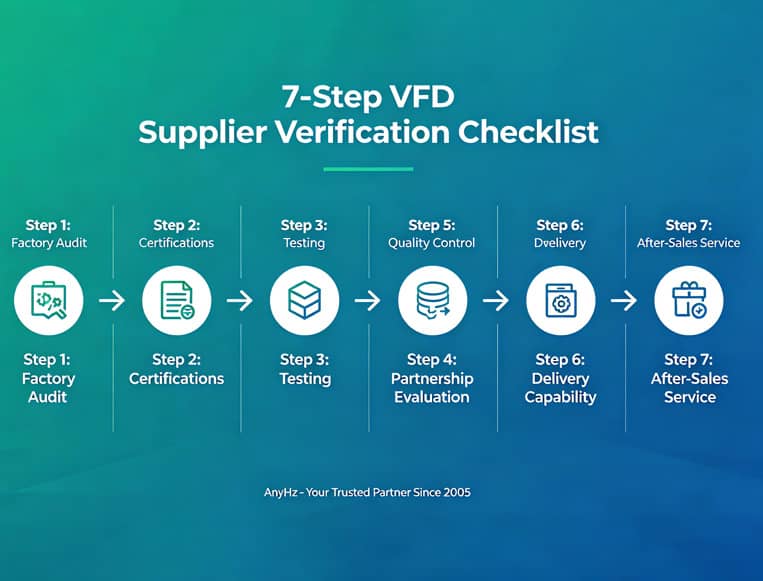
A verified supplier ensures product reliability, technical support, and long-term partnership stability. This guide outlines seven practical steps to thoroughly evaluate a Chinese VFD supplier before committing to procurement.


Step 1: Verify Business Legitimacy & History
What to Check:
  • Business License: Request a copy of the Chinese business license (营业执照) and verify registration via official government databases like the National Enterprise Credit Information Publicity System (国家企业信用信息公示系统).
  • Years in Operation: Established manufacturers (10+ years) typically have refined production processes and proven track records. AnyHz, for example, has specialized in VFD manufacturing since 2005.
  • Registered Capital: Higher capital often indicates stronger financial stability and commitment to long-term operations.
Red Flags:
  • Refusal to provide business documentation
  • Recent registration (less than 3 years) with no verifiable history
  • Mismatched business scope (e.g., trading company claiming manufacturing)
Step 2: Assess Manufacturing Capabilities
Factory Audit Essentials:
  • Production Lines: Visit or request video tours of SMT (Surface Mount Technology) lines, assembly workshops, and testing facilities.
  • Equipment Age: Modern machinery (e.g., Yamaha or Juki pick-and-place machines) ensures precision and consistency.
  • Capacity: Monthly production volume should align with your demand. A legitimate manufacturer can provide specific numbers.
  • In-House vs. Outsourced: True manufacturers perform core processes (PCB assembly, burn-in testing) internally; trading companies outsource everything.
Key Questions:
  • "Can you provide a live video call of your production floor?"
  • "What is your daily/monthly VFD output capacity?"
  • "Do you have your own R&D team and testing lab?"
Step 3: Validate Certifications & Compliance
Mandatory Certifications for Chinese VFDs:
Certification Significance Verification
CE Marking Required for EU export Verify through notified body databases
ISO 9001 Quality management system Request latest audit report
UL/cUL North American safety standard Check UL online directory

Critical Note: Always verify certificate authenticity using the certificate number on official databases. Fake or expired certifications are common in the market.

Step 4: Evaluate Technical Expertise & R&D
Indicators of Technical Competence:
  • Patent Portfolio: Ask for invention or utility model patent certificates related to VFD technology.
  • Software Copyright: VFD control algorithms require proprietary software; legitimate developers hold copyrights.
  • Engineering Team: Inquire about R&D staff numbers and qualifications. A credible manufacturer employs 15-30% of staff in R&D.
  • Customization Ability: Can they modify firmware for specific applications (e.g., crane control, textile machinery)?

AnyHz Example: Our FST-650L series vector control VFDs are developed in-house with proprietary algorithms, supported by a 25-person R&D team and multiple software copyrights.

Step 5: Conduct Product Testing & Quality Checks
Pre-Purchase Validation:
  1. Sample Evaluation: Order 1-2 units for bench testing under your actual load conditions.
  2. Burn-In Test: Run the VFD at full load for 48-72 hours to check thermal stability and component reliability.
  3. Protection Function Tests: Verify overcurrent, overvoltage, and short-circuit protection responses.
  4. EMC Testing: If applicable, test electromagnetic compatibility in your installation environment.
Quality Documentation to Request:
  • Incoming material inspection reports (IGBTs, capacitors)
  • Production process control records
  • Final test certificates (voltage, current, temperature, insulation resistance)
Step 6: Review Customer References & Case Studies
Verification Methods:
  • Existing Clients: Request 2-3 reference customers in your region or industry. Contact them directly.
  • Case Studies: Look for detailed application stories (like the CNC grounding or tissue machine cases) that demonstrate real-world problem-solving.
  • Online Presence: Check the supplier's website (e.g., www.anyhz.com) for technical articles, white papers, and industry-specific solutions—not just product catalogs.
Warning Signs:
  • No verifiable customer references
  • Vague claims without supporting data
  • Website with only generic product photos and no technical depth
Step 7: Evaluate After-Sales Support & Warranty
Service Commitments to Confirm:
  • Warranty Period: Standard is 12-18 months; premium suppliers offer 24 months.
  • Technical Support: Availability of English-speaking engineers for remote troubleshooting.
  • Spare Parts Availability: Guaranteed 5-10 year supply of critical components.
  • Return/Replacement Policy: Clear process for DOA (Dead on Arrival) or early failure units.
Partnership Indicators:
  • Willingness to sign quality agreements
  • Proactive communication about product updates
  • Investment in long-term relationship (e.g., training sessions, joint marketing)
Red Flags: When to Walk Away
? Red Flag Why It Matters
Prices 30%+ below market average Likely counterfeit components or skipped testing
No factory address or virtual office only Probably a trading company
Refuses third-party inspection Hiding quality issues
No technical documentation in English Limited export experience
Unwilling to provide sample for testing No confidence in product quality
Conclusion: Building Trust Through Verification

Verifying a Chinese VFD supplier requires diligence, but the effort pays dividends in product reliability, supply chain stability, and total cost of ownership. The seven steps—business verification, factory assessment, certification validation, technical evaluation, product testing, reference checks, and support confirmation—create a comprehensive vetting framework.

Final Recommendation: Start with a small trial order, maintain open communication, and gradually scale as trust and performance are proven. A verified supplier like AnyHz, with over two decades of manufacturing expertise, transparent processes, and global certifications, can become a strategic partner in your automation journey.

Ready to Verify AnyHz?
  • Business License: Available upon request
  • Factory Tour: Virtual or on-site visits welcome
  • Certifications: CE, ISO 9001 (all verifiable)
  • Sample Testing: Contact sales@anyhz.com for evaluation units
×

Contact Us

captcha
×

Inquire

*Name
*Email
Company Name
Tel
*Message